
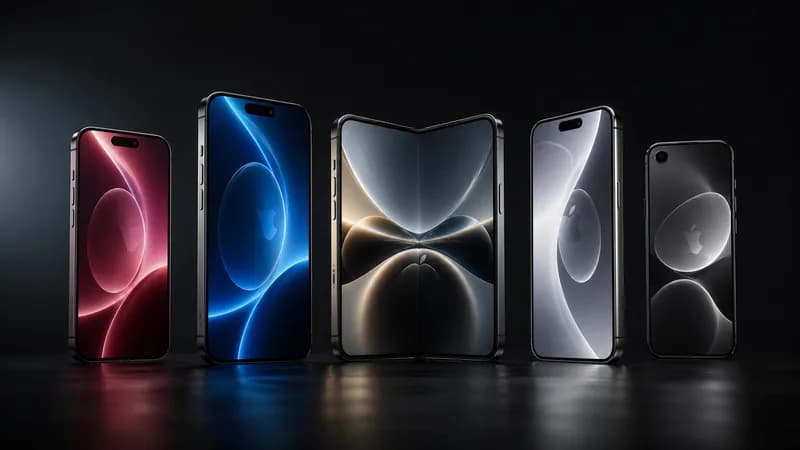
Apple is rewriting the rules for 2026. For the first time since the original iPhone launched in 2007, the Cupertino giant is splitting its annual September iPhone event into two distinct windows — and the reason is as simple as it is bold: the iPhone Fold, Apple's first-ever foldable smartphone, demands centre stage. The result is the most complex, most exciting, and most talked-about iPhone launch in a decade. Welcome to the complete guide to the iPhone 18 series.
In this guide you will find every confirmed leak, credible rumour, analyst prediction, and supply-chain report covering every model in the lineup — from the powerhouse iPhone 18 Pro Max to the wallet-friendly iPhone 18e, from the revolutionary iPhone Fold to the svelte second-generation iPhone Air. Let's dive in.
Table of Contents
- iPhone 18 Release Date & Launch Strategy
- Full Lineup Breakdown: Every Model Explained
- iPhone 18 Pro & Pro Max: Design, Specs & Features
- A20 Pro Chip: Apple's First 2nm Processor
- Camera System: Variable Aperture & More
- Dynamic Island Gets Smaller
- C2 Modem, 5G Satellite & Amazon Leo
- Battery Life Upgrades
- Colors: Dark Cherry, Light Blue & More
- iPhone Fold: Apple's First Foldable Explained
- Standard iPhone 18 & iPhone 18e (Spring 2027)
- iPhone 18 Price: How Much Will It Cost?
- Apple Intelligence & AI Features
- Should You Upgrade to iPhone 18?
- Frequently Asked Questions
1. iPhone 18 Release Date & Launch Strategy
Apple's 2026 iPhone launch is unlike anything the company has attempted in over a decade. Instead of unveiling all models at a single September event, Apple is staggering its releases across two separate windows.
Fall 2026 — September event (premium models):
- iPhone 18 Pro (6.3-inch)
- iPhone 18 Pro Max (6.9-inch)
- iPhone Fold (Apple's first foldable, $2,000+)
Spring 2027 — March/April event (affordable models):
- iPhone 18 (6.3-inch)
- iPhone 18e (6.1-inch)
- iPhone Air 2 (second-generation ultra-thin model)
Bloomberg's Mark Gurman confirmed this split schedule in March 2026. The working theory is two-fold: the manufacturing complexity of Apple's first-ever foldable required a reshuffled production calendar, and Apple deliberately chose to spotlight its highest-margin hardware during the holiday quarter.
Based on Apple's annual cadence, the September 2026 announcement is expected around 8–10 September, with pre-orders opening the following Friday and devices shipping roughly 10 days after. First invitations should land in late August 2026.
2. Full iPhone 18 Lineup Breakdown
Here is a clear side-by-side look at every model expected across both launch windows:
| Model | Screen | Chip | Launch | Est. Price |
|---|---|---|---|---|
| iPhone 18 Pro | 6.3″ OLED | A20 Pro (2nm) | Sept 2026 | $1,099 |
| iPhone 18 Pro Max | 6.9″ OLED | A20 Pro (2nm) | Sept 2026 | $1,199 |
| iPhone Fold | 5.5″ outer / 7.8″ inner | A20 (2nm) | Sept/Oct 2026 | $2,000+ |
| iPhone 18 | 6.3″ OLED | A20 (2nm) | Spring 2027 | ~$799 |
| iPhone 18e | 6.1″ OLED | A20 (2nm) | Spring 2027 | TBC |
| iPhone Air 2 | TBC | TBC | Spring 2027 | ~$999 |
3. iPhone 18 Pro & Pro Max: Design, Specs & Features
The iPhone 18 Pro and Pro Max are not a radical redesign — but the spec sheet tells a story of focused, meaningful upgrades in the areas that matter most to serious users.
Expect the same flat-edged titanium frame and large camera plateau from the iPhone 17 Pro family. Screen sizes stay at 6.3 inches for the Pro and 6.9 inches for the Pro Max. Both feature LTPO+ OLED panels with 120Hz ProMotion, and multiple sources indicate a big jump in display brightness beyond the current 3,000 nits peak.
One interesting detail from a Weibo leak is a slightly transparent ceramic shield section on the back of Pro models, potentially around the MagSafe charging zone. It's unconfirmed and may not survive mass production, but it would add a distinctive premium look.
The Camera Control button introduced with iPhone 16 is staying, but Apple is tweaking it — replacing the capacitive sensor with a pressure-sensing mechanism for improved tactile response.
All iPhone 18 models are expected to ship with 12GB of RAM, up from 8GB in the standard iPhone 17. Base storage stays at 256GB, continuing Apple's 2025 decision to drop the 128GB tier.
4. A20 Pro Chip: Apple's First 2nm Processor
The headline hardware story is the A20 Pro chip, built on TSMC's 2-nanometer process. This is a full node reduction from the 3nm A19 Pro — the kind of leap that historically delivers both meaningful raw performance gains and substantial power efficiency improvements.
Supply-chain analysts project the A20 Pro will be approximately 15% faster and up to 30% more power-efficient than its predecessor. In practice, that means faster app launches, smoother gaming, longer battery life, and significantly more headroom for on-device Apple Intelligence processing.
The A20 chips also use TSMC's Wafer-Level Multi-Chip Module (WMCM) technology, integrating RAM directly onto the same wafer as the CPU, GPU, and Neural Engine. This improves memory bandwidth and reduces power consumption beyond what the node shrink alone delivers.
The standard iPhone 18 and iPhone Fold use a base A20 chip, while the Pro and Pro Max receive the higher-clocked A20 Pro variant.
5. Camera System: Variable Aperture Is the Game-Changer
The most exciting camera upgrade is the introduction of variable aperture on the main 48MP lens — a first for any iPhone. This mechanical feature lets users physically control how much light reaches the sensor, switching between wider settings for low-light shooting and narrower settings for sharp landscape photography.
Variable aperture has long been reserved for high-end DSLR and mirrorless cameras. Analyst Jeff Pu, Digital Chat Station, and multiple supply-chain reports have all independently confirmed this feature. Some sources suggest it may be exclusive to the iPhone 18 Pro Max at launch.
Additional camera upgrades rumoured for the Pro lineup:
- 24MP front camera — up from the current 12MP, enabling sharper selfies and improved FaceTime quality
- Larger telephoto aperture — more light for significantly better zoom photography in low light
- Samsung PD-TR-Logic three-layer stacked sensor — a new architecture improving read speeds and reducing rolling shutter
- Optional teleconverter accessory — to extend effective focal length on the variable aperture lens
6. Dynamic Island Gets Smaller (But Stays)
One of the most visually noticeable changes on the iPhone 18 Pro is a significantly smaller Dynamic Island. Bloomberg reported in February 2026 that Apple is moving some Face ID infrared components beneath the display glass, shrinking the pill-shaped cutout by an estimated 35%.
Earlier reports had suggested a radical redesign — moving the front camera to the upper-left corner in a standalone punch-hole design. However, multiple credible leakers including Ross Young of DSCC and Instant Digital have since walked back those claims. The camera stays in its central position; only the infrared sensor moves under the glass.
The result is a cleaner front display with more usable screen area, while Dynamic Island's interactive Live Activity features remain fully intact.
7. C2 Modem, mmWave 5G, Satellite Internet & Amazon Leo
Apple is debuting its second-generation in-house modem, the C2, replacing both Qualcomm modems and the C1/C1X chips from the iPhone 17. This is one of the most impactful under-the-hood upgrades in the entire iPhone 18 lineup.
Key connectivity improvements:
- mmWave 5G support — dramatically faster speeds in dense environments like stadiums, airports, and city centres
- Full satellite internet via the NR-NTN standard — a massive leap beyond the emergency-only satellite SOS from 2022
- Third-party app satellite access — developers, Apple Maps, and Photos can all use the satellite connection
- Better battery efficiency during 5G usage — a long-standing weakness of previous Qualcomm implementations
In April 2026, Amazon announced its acquisition of Globalstar — the company powering iPhone satellite connectivity since 2022. This means iPhone 18 satellite features will run on Amazon's Leo satellite network, significantly expanding coverage and capability compared to the legacy Globalstar infrastructure.
Wi-Fi remains on the N1 chip (Wi-Fi 7, Bluetooth 6, Thread) introduced with the iPhone 17 line. No N2 chip is expected for 2026.
8. Battery Life: The Biggest Yet
The combination of the more efficient 2nm A20 Pro chip and a physically larger battery makes the iPhone 18 Pro Max a strong candidate for the best battery life ever recorded in an iPhone.
Leaked supply-chain figures point to a battery capacity of approximately 5,100–5,200 mAh — a meaningful jump over the current Pro Max. Chinese variants with physical SIM trays may land closer to 5,000 mAh due to internal space constraints.
The efficiency gains from WMCM chip packaging — which reduces power losses from inter-chip communication — should further stretch real-world endurance beyond what the raw mAh numbers alone suggest.
9. Colors: Dark Cherry, Light Blue, Dark Gray & Silver
Apple is replacing Cosmic Orange from the iPhone 17 Pro lineup with a new headline shade: Dark Cherry. Macworld's supply-chain source described it in April 2026 as closer to a deep wine tone with a purple tint — sophisticated and understated rather than a flat red.
The full rumoured color palette for iPhone 18 Pro:
- Dark Cherry (new — replaces Cosmic Orange)
- Light Blue
- Dark Gray
- Silver
- Coffee (rumoured via Digital Chat Station — less corroborated)
Black is not returning to the Pro lineup for the second year running. All colors are still in development as of April 2026 and could change before mass production locks in.
10. iPhone Fold: Apple's First Foldable — Everything We Know
The iPhone Fold is the device the entire 2026 lineup is built around. Apple's first foldable opens book-style, with a smaller outer display and a larger, wider inner display — similar to Samsung's Galaxy Z Fold series but with a notably different aspect ratio.
Key specs from credible sources:
- Outer display: approximately 5.5 inches (closed)
- Inner display: approximately 7.8 inches (open) — wider and shorter than Samsung's Fold
- Chip: A20 (2nm)
- RAM: 12GB
- Display panels: Samsung Display has an exclusive three-year deal to produce the foldable OLED panels
- Estimated starting price: $2,000 or above
Engineering validation checks ahead of mass production were already underway in early 2026, confirming Apple is on track for a September 2026 debut. Apple's foldable uses a wider 4:3-ish aspect ratio when unfolded — better suited to the iPad app ecosystem Apple has spent years building.
11. Standard iPhone 18 & iPhone 18e (Spring 2027)
The standard iPhone 18 and budget-tier iPhone 18e are both delayed to spring 2027 — most likely March or April — alongside the second-generation iPhone Air.
iPhone 18:
- 6.3-inch OLED display
- A20 chip (2nm, base variant)
- 12GB RAM (upgraded from 8GB in iPhone 17)
- 256GB base storage
- Same general design as iPhone 17
- Estimated starting price: ~$799
iPhone 18e:
- 6.1-inch display
- A20 chip (2nm)
- Budget entry point for Apple's ecosystem
- Price TBC
iPhone Air 2:
The original iPhone Air underperformed on sales, reportedly due to its single-camera and $999 price. Apple is exploring adding a second camera to iPhone Air 2 to better justify its premium positioning. Spring 2027 is the current consensus for its launch.
12. iPhone 18 Price: How Much Will It Cost?
Apple analyst Ming-Chi Kuo does not anticipate any price increase for the iPhone 18 Pro models despite the higher cost of the 2nm chip and new camera hardware. Apple is expected to absorb those costs to maintain competitive positioning against Samsung's Galaxy S26 Ultra.
Expected US pricing:
- iPhone 18 Pro (256GB): $1,099
- iPhone 18 Pro Max (256GB): $1,199
- iPhone Fold: $2,000+
- iPhone 18: ~$799
- Higher storage tiers (512GB, 1TB): modest price increases possible
Tim Cook acknowledged on Apple's Q1 2026 earnings call that memory costs had minimal impact on current pricing — carefully leaving the door open for future adjustments on higher-tier configurations.
13. Apple Intelligence & AI Features in iPhone 18
The iPhone 18 arrives at a transformative moment for Apple's AI strategy. Apple is pivoting its foundation models to use Google's Gemini as the underlying large language model for Apple Intelligence, replacing its previous in-house approach for certain capabilities.
A redesigned LLM-powered Siri — capable of genuine multi-step reasoning, contextual awareness across apps, and natural conversation — is expected to debut publicly in spring 2026, just months before iPhone 18 launches. The A20 Pro's Neural Engine will handle more AI processing locally, improving speed, reducing latency, and keeping sensitive personal data off external servers.
AI-enhanced features expected at launch:
- Advanced on-device image editing with generative tools in Photos
- Contextual Siri integration across third-party apps
- Real-time transcription and intelligent summarisation in Notes and Voice Memos
- Improved Writing Tools across the entire operating system
- Satellite-connected Photos and Maps for off-grid AI-assisted navigation
14. Should You Upgrade to iPhone 18?
Upgrade if you are on iPhone 15 or older. The A20 Pro chip, variable aperture camera, 12GB RAM, full satellite internet, and longer battery life represent a compelling generational leap. The iPhone 18 Pro Max in particular is one of the strongest upgrade arguments Apple has assembled in years.
Think carefully if you are on iPhone 17 Pro. The design barely changes. Performance is evolutionary rather than revolutionary for everyday use. The variable aperture camera is genuinely new, but if photography is not central to your use case, the iPhone 17 Pro remains exceptional.
Wait if you want the standard iPhone 18. It will not arrive until spring 2027. If the $1,099 Pro price is not comfortable, patience is rewarded with a significantly lower price six months later.
The iPhone Fold is for early adopters. At $2,000+ with first-generation hinge technology and open questions about software optimisation for the large inner display, the Fold rewards enthusiasts. Most people will be better served waiting for Fold 2.
15. Frequently Asked Questions
When does the iPhone 18 Pro come out?
The iPhone 18 Pro and Pro Max are expected in September 2026, likely announced around 8–10 September with shipping approximately 10 days later.
What is the iPhone 18 Pro price?
The iPhone 18 Pro is expected to start at $1,099 (256GB) and the Pro Max at $1,199 (256GB) — unchanged from iPhone 17 Pro pricing.
Does iPhone 18 Pro have variable aperture?
Yes — a variable aperture main camera is one of the most consistently corroborated features across multiple credible sources. It may initially be exclusive to the Pro Max.
What chip is in iPhone 18?
The iPhone 18 Pro and Pro Max use the A20 Pro chip built on TSMC's 2nm process. The standard iPhone 18, iPhone 18e, and iPhone Fold use the base A20, also 2nm.
Will iPhone 18 have satellite internet?
Yes — full broadband satellite internet (not just emergency SOS) is expected, powered by Apple's C2 modem and Amazon's Leo satellite network following Amazon's acquisition of Globalstar in April 2026.
Is there an iPhone 18 foldable?
Yes — the iPhone Fold is Apple's first-ever foldable smartphone, expected in September 2026 at a starting price above $2,000.
When does the standard iPhone 18 release?
The standard iPhone 18 is delayed to spring 2027, expected in March or April alongside the iPhone 18e and iPhone Air 2.
What colors will iPhone 18 Pro come in?
Dark Cherry, Light Blue, Dark Gray, and Silver are the rumoured options. Black is not returning for a second consecutive year.